Weight-Space Programming
Can a text-only model answer questions about an image if you give it one token made from pixels?
In Sparks of Weight-Space Programming, Takehi and colleagues asked an LLM to inspect and edit neural network weights directly. I tried a smaller experiment on my Mac. Could an LLM design a connector between two pretrained models?
One image, one token
SigLIP 2 turns an image into a vector. A small connector projects that vector into Qwen3’s input space, where it becomes one soft token alongside the question. Both models stayed frozen. I fit only the connector, using 40 labeled images and no gradient updates.
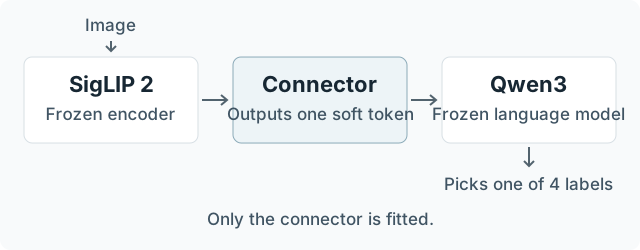
GPT-6.1 Sol wrote a fitting procedure that downweighted variation within each class. GPT-6 Astra wrote a ridge regression procedure that picked its regularization strength using the calibration images. In both runs the LLM wrote the fitting code, and the code computed the connector weights.
Did Qwen use the image?
I gave Qwen four answer choices per image. On the first 100 held-out CIFAR-10 images, Sol’s connector scored 74% and fixed ridge scored 76%. I then ran both connectors and the baseline on a fresh set of 100 images.
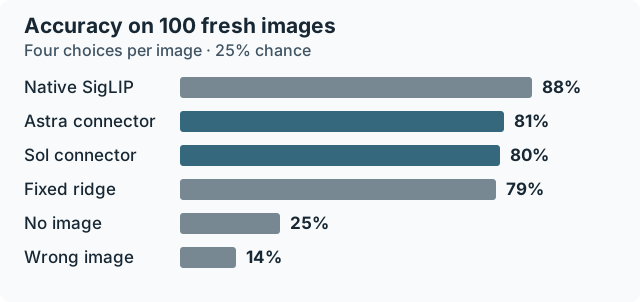
With Astra’s connector, swapping in the wrong image dropped accuracy from 81% to 14%. The image was getting through. Astra’s one-point lead over Sol is too small to call on this sample, and SigLIP’s own image–text scoring still scored highest.
Yes. An LLM designed a connector that let frozen, text-only Qwen use one image-derived token to answer four-choice questions. It got 81 out of 100 right on fresh images, compared with 79 out of 100 for fixed ridge. That shows the connection worked on this task. The two-point gap is too small to establish that the LLM-designed connector was better.
Next, I’d let the LLM try several connector designs, then test its best design against ridge on a fresh set of questions about what’s happening in each image.