Closing the Loop on Local Influence, Storytime Demo
Storytime connects local businesses with creators who visit and share their experiences. My core idea is to follow what happens next: a follower engages with a recommendation, visits the business, and makes a purchase that can be matched back to the offer.
Then use that feedback to help merchants fill quiet periods with discounts shared by creators they approve.
Try the interactive demo — no signup or installation. All purchases are simulated.
From engagement to a confirmed purchase
Storytime already describes creator matching, verified visits, posts, and campaign reporting in its product overview. Its August 2026 Ana Luisa case study reports 30% higher foot traffic using door counts from two weeks before and after launch. That comparison doesn’t establish end-to-end customer purchase attribution or incremental revenue. Storytime may already measure more internally.
I’d explore one explicit chain:
- A creator shares a merchant-approved offer through a link, QR code, or post containing a code.
- A follower opens the offer and visits the business.
- Staff record the creator code on the customer’s order.
- A payment-provider or POS event confirms the transaction; the merchant sees the creator, offer, time, paid amount, and any refund together.
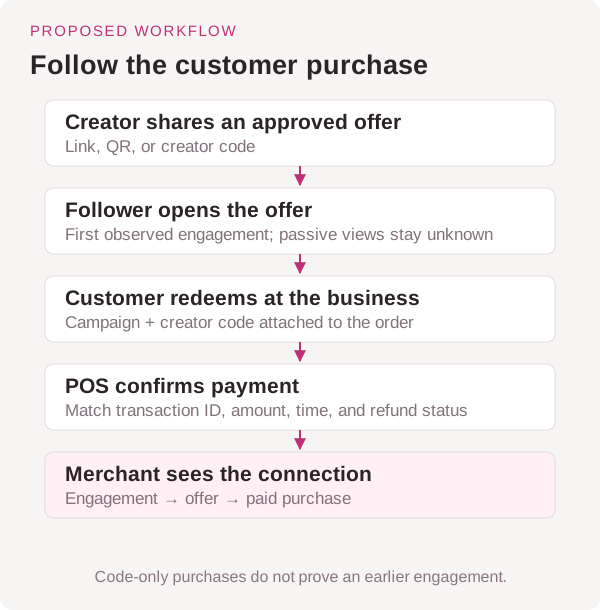
Here, engagement means an observed offer open, not every like or passive view. A code-only purchase can identify an offer without proving an earlier engagement. Shared codes and forwarded links also limit attribution. I’d keep those distinctions visible.
Turn quiet hours into controlled offers
A café with spare afternoon capacity could approve selected creators to share a discount valid from 2–5 PM, capped at twenty redemptions. A restaurant could target a slow service; a spa could release unfilled appointments.
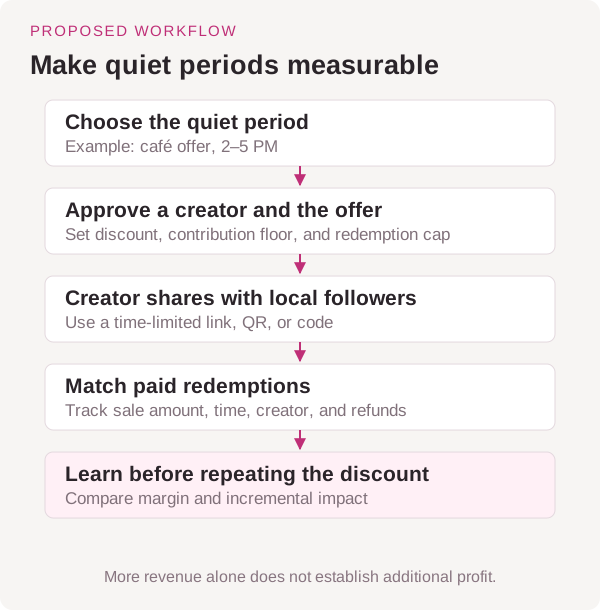
The goal is profitable use of spare capacity. More revenue isn’t automatically better: discounts need to cover variable costs and avoid unnecessarily replacing full-price purchases. I’d compare matched sales, refunds, contribution margin, and redemption times, then test repeat visits and incremental impact against a comparison group.
What I built, and what comes next
The click-through prototype demonstrates merchant approval, time windows, creator links and QR codes, in-store code redemption, purchase matching, and refunds. It runs on GitHub Pages with sample events stored in the visitor’s browser. It does not verify real payments.
A production version needs a backend: merchant-authorized POS access, campaign and order identifiers, verified provider events, duplicate protection, refund reconciliation, and a shared redemption cap. I’d start with one POS integration and retain only the attribution data customers and merchants authorize, consistent with the privacy policy.
I want to work close to customers, help shape how people discover local businesses, and take responsibility for what I ship. I’d start with one merchant, one creator, and one traceable purchase before expanding the workflow.
Interesting threads explored while researching Storytime
- Creator discovery & eligibility. App Store reports about disappearing offers initially led me toward explainable matching and transparent ranking. I’d still validate those experiences with creators; they don’t establish a cause or the current product’s behavior.
- The Local Proof Loop. The focus here is observed engagement → visit → matched purchase → repeat customer. Foot traffic is useful evidence, but the public case study doesn’t establish that entire chain.
- Verifying purchases without friction. I compared POS integrations, card-linked transactions, and permissioned email receipts with Hummingbirds’ receipt-upload approach. Merchant coverage, consent, and matching quality decide whether manual uploads can disappear.
- Beyond influencer marketing. Merchant-approved quiet-hour offers could connect merchants, creators, and consumers around spare capacity. Shopify’s commerce tools and ClassPass’s capacity model provide context; creator storefronts and broader discovery remain longer-term ideas to validate.
- Engineering exploration. Local Proof now demonstrates the purchase-and-offer flow in a browser. The earlier Creator Compass eligibility engine remains a separate, unbuilt proposal. Real transaction verification requires a backend and a payment-provider integration.
Storytime sources: Creator terms · Brand terms · Privacy · Data deletion · Ana Luisa case study · Creator App Store · Signal.
Purchase verification: Square Orders API · Toast Orders API · Stripe email receipts · Hummingbirds Offers.
Marketplace context: Shopify local pickup · ClassPass on filling unused spots.
Storytime — Product Diagnostic & Creator Compass MVP (3-page PDF)
The PDF records the earlier eligibility-focused research; the interactive demo now focuses on purchase attribution and quiet-hour offers.